
Have you ever caught yourself pressing your fingers into the back of your neck after a long day at the computer, wondering why everything feels so stiff? Hours of looking at monitors and scrolling on your phone can make your head feel heavy, your neck sore, and your shoulders as hard as rocks. Over time, this “tech neck” pattern can turn into forward head posture, where your head quietly drifts further and further in front of your body.
For many students and desk workers, a short upper-body routine that focuses on posture is more practical than a full workout. This 15-minute upper-body stretch routine is designed to gently support better alignment in your neck, shoulders, and upper back. You can do it at home or at the office, and you do not need any special equipment—just a wall, a doorway, and a chair. This 15-minute upper-body stretch routine is designed to gently support better alignment in your neck, shoulders, and upper back as you work on forward head posture.
Note: If you have severe neck pain, radiating pain, dizziness, or a diagnosed spine condition, please talk with a healthcare professional before starting a new routine.
Step 1: Gentle Warm-Up to Relax Your Upper Body

Before you focus on posture, it helps to calm your nervous system and release some baseline tension.
Seated breathing to release shoulder tension
- Sit back in your chair with your lower back supported by the backrest.
- Place your feet flat on the floor and let your hands rest on your thighs.
- Inhale slowly through your nose, allowing your ribs to expand.
- Exhale gently through your mouth, letting your shoulders relax and drop away from your ears.
- Repeat this calm breathing about 5 times.
Even a few rounds of slow breathing can help your shoulders soften so the following stretches feel smoother and less abrupt.
Shoulder rolls to prepare your neck and upper back
- Stay seated tall with your spine as straight as is comfortable.
- Lift both shoulders up toward your ears, then roll them backward in a large, smooth circle.
- Continue this motion 10 times, then switch directions and roll the shoulders forward 10 times.
This short warm-up wakes up the muscles around your neck, shoulders, and upper back so they are ready for more targeted posture work.
Step 2: Key Neck Stretches for Forward Head Posture
This phase focuses on the front, sides, and back of your neck to support healthier head alignment. Many posture guides include versions of these movements for forward head posture.
Chin tuck: teaching your neck its natural position
- Stand with your back against a wall or sit upright in a chair with your spine tall.
- Keep your eyes looking straight ahead.
- Place two fingers on the front of your chin.
- Gently press your chin straight back, as if you are making a small double chin, until you feel the back of your neck lengthen.
- Hold for about 5 seconds, then relax.
- Repeat 10 times with smooth breathing.
It may not look pretty, but this simple chin tuck is one of the core movements used to help correct forward head posture and activate the deep neck muscles.
Side-of-neck stretch
- Sit or stand tall with your shoulders relaxed.
- Place your right hand over the left side of your head.
- Gently draw your head toward your right shoulder until you feel a stretch along the left side of your neck.
- Keep your left shoulder heavy and relaxed, not lifted.
- Hold for about 15 seconds, breathing slowly.
- Return to the center and repeat on the other side.
This stretch targets tight muscles along the side of the neck that often work overtime when your head drifts forward.
Front-of-neck stretch
- Sit or stand with an upright posture.
- Lift your chin just slightly, as if you are looking a bit above the horizon.
- Place both hands lightly on top of your collarbones.
- Gently tilt your head back a little more until you feel a stretch along the front of your neck and upper chest.
- Hold for about 15 seconds, then return slowly to neutral.
Together, these three neck stretches form the foundation of your forward head posture routine and help balance the muscles around your neck from different angles.
Step 3: Open Your Chest and Upper Back for Better Posture
Forward head posture rarely happens alone; it often comes with rounded shoulders and a collapsed chest. This phase focuses on your upper back, chest, and shoulder position.
Wall posture reset (head–shoulder–hip alignment)
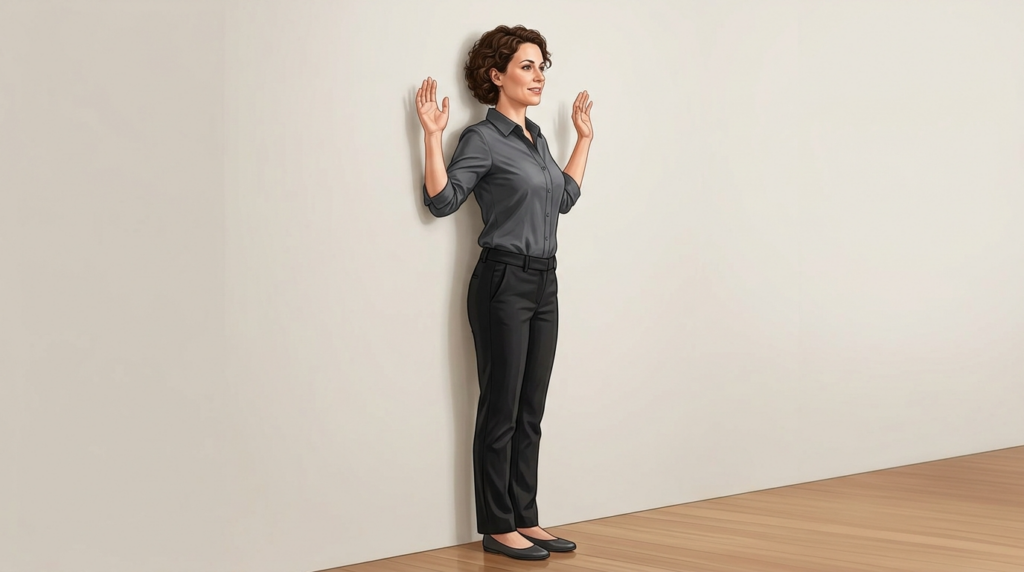
- Stand with your back near a wall.
- Gently touch the back of your head, your shoulder blades, and your pelvis to the wall.
- Tuck your chin slightly, as you did in the chin tuck exercise, to keep your head from sliding forward.
- Hold this position for about 20 seconds while breathing slowly.
- Relax and repeat 2–3 times.
This wall alignment exercise gives your body a clear reference for what “stacked” posture feels like, and it pairs well with chin tucks for forward head posture.
Doorway chest opener
- Stand in a doorway or near the corner of a wall.
- Lift your elbows to about shoulder height and bend them to 90 degrees, placing your forearms on the door frame.
- Step one foot forward.
- Gently lean your chest forward until you feel a stretch across the front of your chest and shoulders.
- Hold for about 20 seconds, then relax.
- Repeat 2–3 times, switching which foot is in front if you like.
This chest-opening stretch helps counteract the rounded shoulder posture that often goes with tech neck.
W-shaped shoulder squeeze
- Stand or sit tall with your arms down by your sides.
- Bend your elbows and bring your arms up into a loose “W” shape beside your body, palms facing forward or slightly outward.
- Gently squeeze your shoulder blades toward each other, as if you are trying to lightly pinch a pencil between them.
- Hold for 3–5 seconds, then relax.
- Repeat 10 times with controlled movement.
This exercise wakes up the muscles between your shoulder blades, which support better upper-back posture and help your neck carry less of the workload.
Putting It Together: A 15-Minute Habit for Forward Head Posture
When you perform these movements slowly, breathing steadily, this upper-body stretch routine for forward head posture takes about 15 minutes:
- A few minutes of breathing and shoulder rolls to warm up.
- Several rounds of chin tucks and neck stretches for the front, sides, and back of your neck.
- Wall posture, doorway chest openers, and W-shaped shoulder squeezes to open the chest and activate your upper back.
You do not need to aim for a perfect posture or force your range of motion. Focus on gentle, comfortable stretches and smooth control. Practiced at the same time each day, this 15-minute upper-body routine can become a simple habit that helps support healthier head and shoulder alignment over time.
You might also like these 15-minute routines
If you spend long hours sitting at a desk, you may also like my 15-Minute Back Stretch Routine for Desk Workers. It focuses on gentle mobility, stretching, and light strengthening to make your lower back feel lighter after long periods of sitting.
For students and knowledge workers who feel stiffness all over the body, try my 15-Minute Full-Body Stretch Routine for Long Study Sessions. It is designed to help your whole body recover from extended hours of reading, writing, or computer work.
If neck and shoulder pain are your main concern, you can follow my 15-Minute Neck and Shoulder Stretch Routine for Desk Workers for a focused series of stretches around your upper back, shoulders, and neck.
FAQ: Upper-body stretch routine for forward head posture
Q1. How often should I do this 15-minute upper-body stretch routine?
For most desk workers and students, doing the full routine once a day is a good starting point. On busy days, you can still benefit from shorter “mini sets” of chin tucks, side-of-neck stretches, or doorway chest openers during screen breaks.
Q2. Can this routine completely fix forward head posture by itself?
This routine can help support better alignment and reduce stiffness, but it is not a magic cure. Forward head posture usually develops over months or years, so lasting change comes from a combination of regular stretching, strengthening, and daily posture habits like screen height and sitting position.
Q3. What if I feel pain, numbness, or dizziness during one of the exercises?
Gentle stretching or mild effort is normal, but sharp pain, burning, numbness, tingling, or dizziness are warning signs. If you notice these symptoms, stop the exercise, return to a neutral position, and rest. If they keep coming back or get worse, consult a healthcare professional before continuing.
Q4. Do I need special equipment or an ergonomic chair for this routine to work?
You do not need any special tools; a chair, a wall, and a doorway are enough to perform the exercises. However, combining this routine with basic ergonomic changes—such as raising your monitor, bringing the keyboard closer, and supporting your lower back—can make your results more noticeable and longer lasting.
Q5. How long will it take before I notice a difference in my posture?
Some people feel lighter and more open across the chest and shoulders after the first session. For visible posture changes, it usually takes several weeks of consistent practice, especially if you have had forward head posture for a long time. Think of this routine as a daily investment in your future neck and shoulder comfort.
Learn more about forward head posture and desk posture
If you want more detail on exercises and stretches commonly recommended for forward head posture, this Healthline article gives clear instructions and safety notes:
https://www.healthline.com/health/bone-health/forward-head-posture
For a broader look at how posture, monitor height, and shoulder position affect forward head posture and neck pain, this guide from a chiropractic and rehabilitation perspective may also be helpful:
https://transformchiropractic.com/forward-head-posture-exercises-toronto/
Leave a Reply